
Price is a major factor when purchasing a ropes course or other adventure or training installation. For all our Customers, value for money is paramount.
But how do you identify value for money when confronted with quotations that are laden with jargon?
We have written some notes below to help guide you through the decision-making process.
The most important rule, before asking for quotes, is to create a specification.
Often in the world of high ropes and assault courses, decisions, sometimes involving tens of thousands of pounds are made without a true like-for-like comparison. Quotations can be for very different structures, built to differing standards using different materials.
We came to this realisation many years ago when we heard that a Jacobs Ladder that we had quoted for, but did not win, had to be demolished. The poles, which were ground placed, had rotted and the owners – a branch of HM services – did not have the funds to replace. Our quote was for poles in steel boots and was apparently one thousand pounds more than the model chosen. Ours would still be standing today!
- Before you do anything else you need to know what you want to do with you adventure construction – whether it be a rope course, zip wire or assault course. Are you using it for recreation, training or purely to make money – or a combination of these?
- Once you have decided you will be able to prepare a specification – types of materials, foundations, site finishing, warranties, etc.
- You will never get value for money if you do not send out the same specification to the companies that you are asking to quote. You must be able to compare like for like. Altering the design and configuration is fine at the initial ‘notional’ stage – but once you have decided what you want, you then need to write the specification that you will send out. An example specification can be downloaded HERE.
- A specification sheet also allows you to dictate the budget – only you can decide if you want a top-of-the-range or value-engineered construction.
- Any supplier will be happy to assist you in the preparation of a specification. Time and effort spent now could save time and money when your project is built.
A Rope Course specific example.
The two shackles show below are both 3.25 ton bow shackles and will do exactly the same job. The purple pin model costs around £5 depending on where you buy and discounts you receive. The green pin costs around £11 – same reasons.
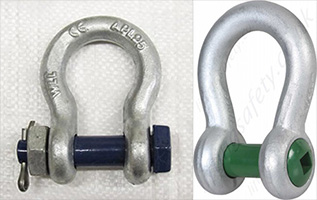
One has a bolt, nut and spit pin – the other a pin which is tightened with a square key tool. The purple will require physical inspection and periodic split pin replacement.
The green pin just needs to be looked at because these shackles are used in the fishing industry because once done up they don’t come undone. Also they are are smooth and the purple are not – important if participants hands get close.
The green pin is far more user friendly and requires far less work at inspection time.
If a course has 100 shackles the the purple will cost £500 pounds the green £1100.
If the specification just says ‘3.25 ton bow shackles’ one provider may quote using purple pin to keep their prices down and win the work – the other who quotes on green pin is trying to provide a better product and a better customer service.
And you, the customer, don’t get a like for like quote – you just see that one quote is £600 less then the other?
Specifications matter!